Dalian Eastern Display Co., Ltd.
Dalian Eastern Display Co., Ltd.

2025-12-24
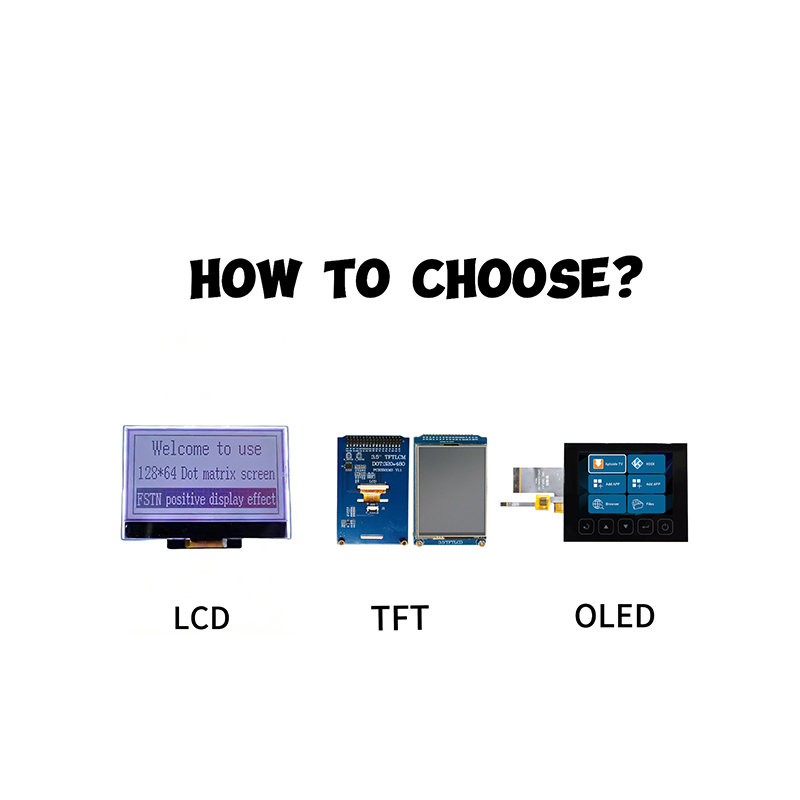
In industrial control applications, the selection of display solutions hinges on balancing reliability, environmental adaptability, and total cost. The fundamental differences among monochrome dot-matrix LCDs, OLEDs, and TFTs directly determine their distinct performance in demanding industrial environments.
| Dimension of consideration | Monochrome dot matrix LCD | OLED display | TFT display |
| Wide Temperature and Reliability | Significant advantage | Excellent at low temperature | Significant advantage |
| Most rugged and durable: Featuring standard COG packaging, it effortlessly withstands temperatures from-30°C to 85°C, with select models capable of operating at-40°C to over 90°C. | Rapid response to low temperatures: Organic materials can still function normally at-40°C, but aging accelerates at high temperatures (>70°C). | Excellent performance: Operating temperature typically ranges from-30°C to 70°C. Under extreme low temperatures, the liquid crystal response becomes slower. | |
| Life and Stability | Extremely long lifespan: The liquid crystal material itself shows minimal degradation, with its lifespan determined by the backlight LED (typically exceeding 50,000 hours). No burn-in risk. | The lifespan is a limitation: organic materials degrade continuously, and high-brightness static displays are prone to burn-in (residual image). | Extremely long lifespan: Like dot-matrix LCDs, backlight degradation is the primary lifespan constraint. No burn-in issue. |
| High light readability | Backlight-dependent design: Performance is average indoors or under sunlight (especially with reflective/semi-transparent designs). High-intensity backlighting is required for visibility in bright light, which increases power consumption. | Indoor performance is optimal: self-illumination with extremely high contrast, ensuring clear visibility indoors or in low-light conditions. However, under outdoor strong light, ultra-high brightness is required to counteract ambient light, leading to a significant increase in power consumption and accelerated aging. | High-brightness backlighting is typically required: Similar to dot-matrix LCDs, visibility in bright light depends on the backlight intensity. |
| Comprehensive cost analysis | The lowest procurement cost: mature technology and stable supply chain, with a 3.5-inch module reference price of approximately tens of RMB. | The highest procurement cost: Due to complex materials and manufacturing processes, the price per unit size is typically several times higher than that of LCD panels. | Moderate procurement costs: mass production keeps prices moderate, though touch-enabled models incur substantially higher costs. |
| Features and Integration | Single function: Displays characters, numbers, and simple graphics. Has a low refresh rate and may show trailing effects. Simple interface (e.g., SPI interface). | Excellent performance: Ultra-high refresh rate, no ghosting, and smooth animation display. Flexible interfaces. Can be used as a flexible screen. | Powerful: Can display complex grayscale images and UI interfaces. |
Based on the analysis above, the selection of industrial control systems can follow these guidelines:
* Your device operates in harsh environments with extreme temperatures and high vibration, such as outdoor power cabinets or vehicle-mounted industrial PCs.
* The display primarily features static icons, segment displays, digital segment displays, and basic status indicators (e.g., PLC status screens and instrument readings).
* Highly cost-sensitive, prioritizing maximum stability and longevity.
* Core reminder: This is the most conservative and reliable industrial option, which is unlikely to fail in most cases.
* The equipment is primarily designed for maintaining a constant temperature and clean indoor environment (e.g., laboratory instruments, high-end control consoles).
* Requires high display quality, wide viewing angles, and fast response times, with dynamic effects.
* The equipment must have ultra-thin or irregularly shaped designs.
* Core reminder: Strictly avoid screen burnout risks at the design and software levels (e.g., set screensavers, dynamic pixel displacement).
* The device requires a sophisticated graphical human-machine interface or must incorporate touch functionality.
* The working environment temperature is relatively stable (typical industrial indoor environment).
* A better balance between display performance and cost is needed.
* Core reminder: This upgrade option transitions from “simple display” to “interactive interface”.
III. Key Details to Clarify Before Deep Selection
To make the best decision, we recommend you first clarify the following four specific questions:
If you could provide these more specific parameters, I can offer you more targeted model recommendations or solution evaluations.
As a traditional and well-known LCD manufacturer in the Chinese mainland, Eastern Display began designing and producing LCD, TFT, and OLED products as early as the 1990s. Its products are widely used in industrial control, medical electronics, automotive electronics, and other fields, earning high praise and recognition from customers in these areas.